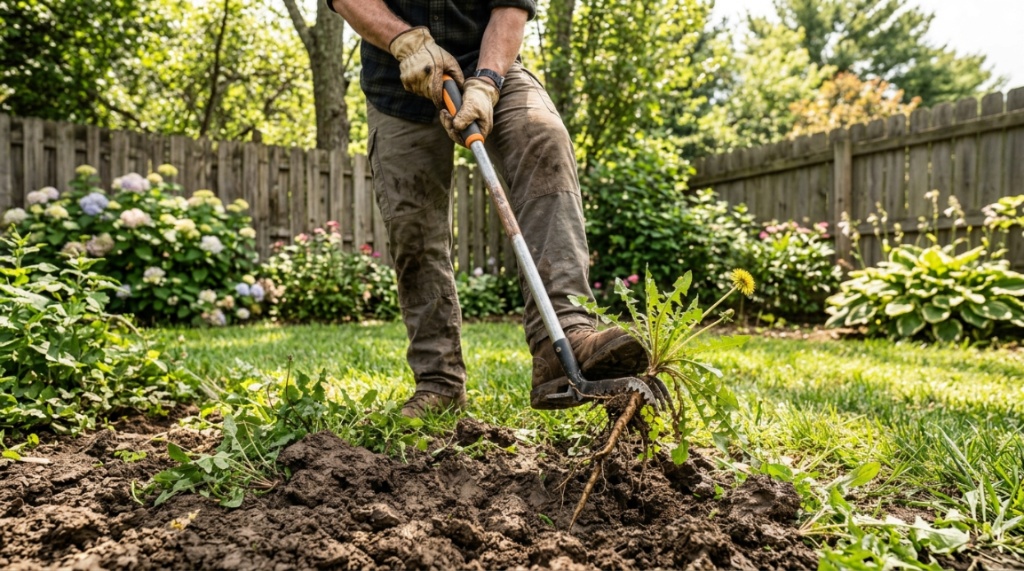
If you garden in Ohio, you already know the frustration: one week you’re pulling dandelions with ease, and the next you’re wrestling with a stubborn thistle root buried in heavy clay. The state’s mix of sticky clay, rocky glacial till, and sandy loam makes weed removal a legitimate challenge. A traditional hand trowel wreaks havoc on your knees and back, but a standard stand-up weeder often snaps or bends when it meets the dense, compacted ground typical of the Buckeye State. You need a tool that can handle torque and hard soil without making you stoop. This guide is designed to help you find the right stand up weeder for Ohio soil by breaking down the specific mechanical features, handle designs, and head styles that actually perform well in our unique growing conditions.
Key Takeaways
- Prioritize head strength: Look for a weeder with a solid, one-piece steel head (not a stamped or folded metal design) to withstand Ohio’s rocky and clay-heavy soil without bending.
- Choose the right foot step: A wide, serrated foot pedal is essential for penetrating hard-packed clay, as it allows you to apply your body weight safely and effectively.
- Consider the extraction mechanism: For deep taproots like dandelions and thistles, a two-prong or lever-action head is more effective than a simple V-cutter, which primarily works for shallow weeds.
- Match the handle to the user: The handle length must match your height, and you should opt for a cushioned grip to prevent blisters during long sessions in the garden.
- Soil-specific design matters: Avoid tools designed for soft, sandy soils; they lack the leverage and sharpened edges necessary to cut through dense Ohio clay and glacial till.
Why Ohio Soil Is So Tough on Weed Pullers
Before you can select the best tool, it helps to understand what you are fighting against. Ohio isn’t a single soil type; it is a patchwork of glacial deposits and sedimentary layers. The most common challenges are:
- Clay Soil: When dry, clay becomes hard and brick-like. When wet, it turns sticky and clings to metal, which can clog the weed puller and render it useless.
- Glacial Till: This contains a mixture of clay, sand, gravel, and rocks. Hitting a small boulder just under the surface is common and can blunt a weak blade instantly.
- Shallow Topsoil: Many suburban developments in Ohio have very little healthy topsoil, sitting directly on dense subsoil that resists penetration.
This combination means you need a tool with significant mechanical advantage. If you use a cheap, lightweight weeder, the handle often twists or the head snaps off when you encounter a rock. Finding the right stand up weeder for Ohio soil requires looking beyond marketing claims and focusing on the gauge of steel and the quality of the fulcrum.
The Mechanics: How a Stand Up Weeder Actually Works
To make an informed purchase, you must understand the mechanics. A stand-up weeder is essentially a lever system. You push the head into the ground, use your body weight to sink it deep enough to catch the root, and then pull back on the handle to lift the soil and the weed out.
The Lever Principle
The longer the handle, the more leverage you have. However, in Ohio’s hard soil, leverage isn’t just about length; it is about the fulcrum point. When you step on the pedal, the fulcrum is at the base of the head. If the head is too narrow, the tool will rock and struggle to maintain its angle. A wider head provides stability in uneven ground.
Head Design and Penetration
The shape of the head determines how the tool enters the soil. A sharp, pointed tip cuts through compacted dirt, while a flat edge is easily deflected by rocks. For Ohio soil, you want a head that is slightly curved or has a chisel point to find a path between obstacles.
Key Features to Look For in an Ohio-Ready Weeder
Not all weeders are created equal. Here are the non-negotiable specifications you should look for when shopping, whether online or in a local hardware store.
1. Solid Steel vs. Stamped Steel
Stamped steel heads are cut from a flat sheet and bent into shape. They are cheap and lightweight, but they have weak points at the bends. If you put your weight on a stamped head in clay soil, it will bend. Look for a “forged” or “cast” head, or at minimum, a head that has a thick cross-section (at least 3/16-inch thick). A solid steel head will push through dense soil without flexing.
2. The “Grip-and-Pull” vs. “Pop-Up” Mechanism
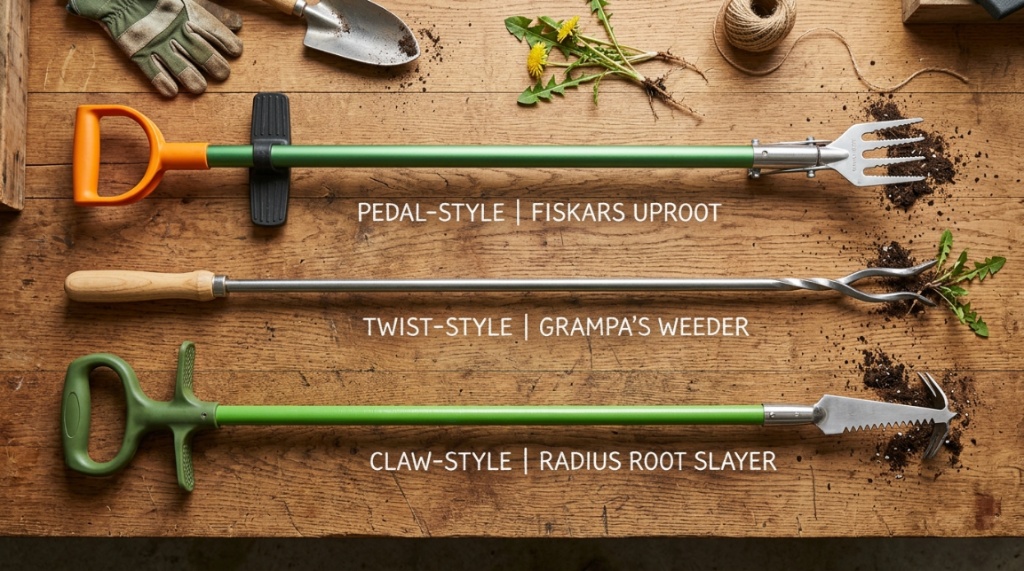
There are two main types of stand-up weeders:
- The V-Cutter: This is a simple V-shaped blade that you step on to slice the root below the surface. It is fast, but it doesn’t remove the weed; it only cuts the top off. In Ohio clay, this is a temporary solution because roots regenerate quickly.
- The Extractor (Two-Prong): This tool has a forked head that goes down on either side of the root. When you press the handle down, a lever mechanism clamps the prongs together and lifts the entire root out. This is far superior for Ohio’s common taproots, though it requires more physical strength to pull the handle.
- The Lever-Action: This is similar to the extractor, but it uses a sliding collar to pull the weed out without requiring you to pull backward with your arms. This is often the best choice for heavy clay because it allows you to push down on the handle rather than pull up, maximizing your strength.
3. Foot Pedal Design
A narrow foot pedal is a safety hazard. When you push down on a narrow pedal, your foot can slip off, causing you to lose balance. Look for a wide, serrated pedal that provides a firm grip for your boot.
4. Handle Grip and Ergonomics
In Ohio, we often have to yank weeds out of frozen or hard soil in the spring and fall. This creates friction and vibration. A rubberized, cushioned grip is not a luxury; it is a necessity to prevent blisters and joint strain. Look for handles with a “D-grip” or a padded crossbar that allows you to use both hands comfortably.
How to Use a Stand Up Weeder Effectively in Hard Ground
Most people buy a weeder and go straight to the dirt. That often leads to frustration. To get the most out of your tool in Ohio conditions, follow this process:
- Water First (or Wait for Rain): The most crucial mistake is weeding when the soil is bone-dry. In Ohio, clay soil turns to concrete in July. Try to weed one or two days after a heavy rain. If there is no rain in the forecast, water the area deeply the evening before. This softens the soil and allows the steel head to sink in without needing explosive force.
- Position the Tool Vertically: Place the head directly over the center of the weed. The tool must be as vertical as possible. If you angle it, the head will skip off the surface instead of penetrating.
- Use Your Weight, Not Your Ankles: Place your foot firmly on the pedal and shift your weight slowly. Do not stomp. Stomping drives the tool down too fast, and if you hit a rock, the impact transfers directly to your knees.
- Leverage, Then Lift: Once the head is at the desired depth (usually 2-3 inches for dandelions), pull the handle toward the ground (or push down, depending on the mechanism). If the tool has a sliding collar, push it down to clamp the root. Then, gently pull the tool straight up out of the soil, holding the weed in the jaws.
Maintenance and Longevity: Protecting Your Investment
Since you are spending money on a heavy-duty tool, you should take care of it so it lasts for decades. Ohio’s climate—with its freezing winters and humid summers—can cause rust and corrosion.
Cleaning and Rust Prevention
After each use, hose off the head to remove sticky clay. If left to dry, this clay can actually trap moisture and cause the metal to pit. Store the tool in a dry place. Once a season, wipe the metal head with a light coat of boiled linseed oil or a silicone spray. This prevents rust and makes the tool slide into the soil more easily. Do not use a heavy grease, as it will attract dirt.
Sharpening the Blade
Most stand-up weeders are not sharpened at the factory to a razor edge because they need to withstand impact. However, sharpening the tip and the inner edges of the prongs with a flat file once a year will drastically reduce the amount of force you need to apply. A sharp tool cuts through grass roots and clay fibers, while a dull tool crushes them, making the job harder.
Common Mistakes When Buying Weeders for Ohio Gardens
Understanding what not to do is just as important as knowing what to look for. Many Ohio gardeners end up with a shed full of broken tools because of a few common purchase errors.
Mistake 1: Buying for Weight, Not Strength
Shoppers often pick up a weeder and think, “This is light, so it will be easy to use.” In Ohio, lightweight often means thin metal. While you don’t want a tool that is exhausting to lift, you need a tool with enough heft to stay grounded. The weight helps the head drive into the soil. Look for a tool that weighs at least 3 pounds, Heavy compaction and poor drainage are common Two problems that soil experience across the Midwest, making the choice of weeding equipment critical for your lawn care routine.
Mistake 2: Ignoring the Root Type
If you are dealing with crabgrass or annual weeds with shallow roots, a simple V-cutter is fine. But if you are combatting dandelions, thistles, dock, or plantain (all common in Ohio), you need a deep extractor. Before buying, identify your enemy. If you have a dandelion problem, always choose the two-prong extractor.
Mistake 3: Forgetting About the “Push” Factor
Some stand-up weeders require you to step on the head to hold it in place while you push the handle down. This requires hand strength. If you have arthritis or limited grip strength, look specifically for weeders labeled “no-bend” or “push-action” that allow you to lift the root with a sliding jaw mechanism rather than a manual clamp.
Comparing the Main Types of Weeders
To help you visualize the differences, here is a breakdown of the three main types of stand-up weeders and their suitability for Ohio conditions:
| Type | Best For | Mechanism | Ohio Soil Suitability |
|---|---|---|---|
| V-Cutter | Annual weeds, young seedlings, soft beds | Slices root under the soil | Poor for clay; roots regrow quickly. |
| Extractor (Claw) | Dandelions, mature taproots | Clamps root and lifts it out | Good; requires strength and correct soil moisture. |
| Lever-Action Puller | Deep taproots in compacted soil | Sliding collar pulls root without arm strength | Excellent; best mechanical advantage for hard ground. |
As you can see, the tool you choose depends heavily on your physical capability and the specific weeds you are targeting. For the majority of Ohio homeowners dealing with broadleaf weeds in lawns, a high-quality lever-action puller is the safest investment.
Physical Considerations and Ergonomics
Stand-up weeders are marketed as “back-savers,” but if you buy the wrong size, they can cause just as much pain.
Sizing the Handle to Your Body
An easy test to ensure the weeder is the right height: stand straight, hold the handle with your arms relaxed at your sides. The foot pedal or head should hover just above the ground at the base of the weed. If you have to reach down significantly, the handle is too short. If the handle hits your armpit, it is too long, and you will lose leverage.
Handle Shapes
A straight handle is easier to store but can twist in your grip if you hit a rock. A “D-handle” or “T-handle” at the top gives you more control over the twisting motion, allowing you to rock the tool back and forth to loosen the soil before lifting. This rocking motion is vital in Ohio clay—it breaks the suction of the wet mud against the metal.
The Right Timing for Weeding in Ohio
Even with the right tool, timing is your biggest ally. In Ohio, the ideal weeding window is in the early spring (April) and late fall (October). Why? Because the weed seeds are just germinating in the spring, making shallow extraction easy. In the fall, the plants are pulling energy back into their roots in preparation for winter. If you pull a dandelion root in the fall, you remove the entire energy store, preventing it from coming back in spring.
Weeding in the middle of a dry spell requires excessive force, which risks bending the tool and breaking the root. If you pull too hard and the root breaks off below the soil line in clay, the plant will laugh at you and regrow. The tool is most efficient right after a soaking rain has softened the top two inches.
Frequently Asked Questions
Can a stand-up weeder work in rocky Ohio soil?
Yes, but you need a heavy-duty model with a pointed tip. A pointed tip can deflect off small rocks rather than catching them. However, you should avoid using a stand-up weeder in extremely gravelly areas, as you may snap the tang (the part that connects the head to the handle) if you hit a large buried boulder. In those areas, a hand weeder offers more control.
Do I need to water the soil before using a stand-up weeder?
It is highly recommended. Watering the evening before (or weeding after rain) softens the clay, allowing the metal head to slide in smoothly. Attempting to use the tool on bone-dry soil requires excessive force and often leads to the weed breaking off at the crown, leaving the root intact.
What is the difference between a stand-up weeder and a hoe?
A stand-up weeder is designed to remove the entire root system of a specific weed without disturbing the surrounding soil. A hoe is designed to chop weeds at the surface or cultivate large areas. The weeder is a precision tool, while the hoe is a bulk tool.
How do I stop the soil from sticking to the weeder head?
Ohio clay is notoriously sticky. To prevent soil buildup, spray the metal head with a silicone-based lubricant or apply a thin coat of vegetable oil before you start. This creates a non-stick barrier. Alternatively, keep a bucket of water nearby and dip the head in it occasionally.
Is a telescoping handle worth it?
Telescoping handles are useful if multiple family members will be using the tool. However, the locking mechanisms can strip over time under the stress of pulling weeds from hard soil. If you are buying for one person, a fixed-length handle that matches your height is more durable and reliable.
Conclusion
Finding the right tool for Ohio soil is about matching mechanical advantage to your physical strength and the unique composition of your garden. Avoid flimsy stamped designs and prioritize solid steel, a sturdy foot pedal, and an efficient extraction mechanism. Remember that the rust-colored clay in your backyard is dense, heavy, and unforgiving—your tools need to be equally heavy-duty. Once you choose a weeder that offers true leverage and use it when the soil is damp, you’ll find that weeding becomes a quick, satisfying task rather than a back-breaking chore. Assess your needs, invest in quality, and tackle those roots head-on.