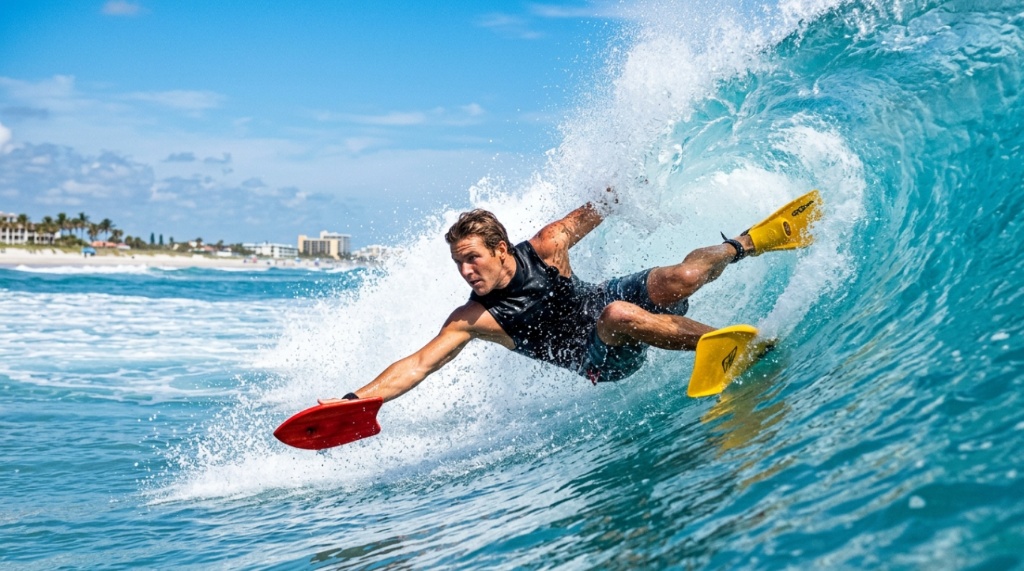
You’ve felt it before—the raw thrill of catching a wave with nothing but your body and a small piece of foam or plastic strapped to your hand. But if you’ve tried bodysurfing in Florida without a handplane, you know the struggle: your arm cuts through the water, your shoulder burns, and you miss the wave entirely. A handplane changes everything. It adds lift, speed, and control. The problem is that Florida’s waves are a mixed bag, from punchy beach breaks in New Smyrna to gentle rollers on the Gulf Coast. One handplane does not fit all. This guide breaks down exactly how to choose the best bodysurfing handplane for your local break, your skill level, and your body type—so you can spend less time guessing and more time riding.
Key Takeaways
- Florida’s wave conditions—typically softer and more crumbly than Pacific waves—favor handplanes that provide maximum lift, not necessarily aggressive down-the-line speed.
- Handplane shape and rocker should match your wave environment. Low rocker works best for mushy Florida waves; aggressive rocker is only needed for steep, barreling days.
- Performance designs like the Wedge or hydrofoil shapes give experience-dependent advantages over simple flat or spoon-shaped models.
- A secure hold is critical in Florida’s often-choppy water; measure your hand and match the strap system to your intended session length and wave size.
- In warmer water, handboards are the more practical choice versus handplanes, though the terms are often used interchangeably.
What Exactly Is a Bodysurfing Handplane?
A bodysurfing handplane is a small, rigid board worn on one hand that adds surface area to your arm, creating lift and allowing you to angle across the face of a wave. Unlike bodyboards, which are ridden with your torso, a handplane keeps your body in a swimming motion. It increases your planing speed and reduces drag, which makes it significantly easier to catch waves that are marginally powerful—exactly the kind of waves Florida frequently produces.
There is an important distinction to make: handplanes differ from handboards. A handplane sits securely on your palm with straps, allowing you to open and close the water resistance across your hand. A handboard, by contrast, is larger and has a more defined fin or rail system, functioning more like a wrist-mounted surfboard. For most Floridians, a standard handplane is the best starting point due to its comfort and versatility in variable wave quality.
Material matters less than profile. High-density foam is excellent for lifting, while polycarbonate or plastic models are faster and more durable. The easiest way to think about it is: foam lifts, and plastic glides. In Florida’s lower-power waves, you will likely prioritize foam.
How Do Florida Waves Affect Your Handplane Choice?
Unlike Hawaii or California, Florida’s Atlantic coast rarely sees steep, dredging barrels. The Gulf Coast, meanwhile, is almost entirely sandbar-driven with long-period summer swells. This matters because handplanes are designed to exploit the face of a wave. Florida waves have less pitch—meaning they break over longer distances with less vertical face. A handplane with too much rocker (curvature from nose to tail) will plow water and slow you down.
Instead, you need a model with a low pro-planing hull. This allows the board to ride on the water’s surface rather than pushing through it. On flatter, faster-breaking sandbars, the board needs to maintain momentum with minimal drag. A nose that is too wide and square can also cause steering difficulty in the bumpy, wind-chopped sections typical of Florida afternoons.
So, rule number one for Florida: choose a lower-rocker profile. You want lift, not steep carving capability. Save the aggressive, high-rocker designs for hurricane swell days—those rare, extra-steep conditions this coast occasionally sees.
Which Handplane Shapes Work Best for Beginners?
If you are new to bodysurfing in Florida, the first choice is often overwhelming because many companies rely on intricate wedge shapes and hydrofoil-inspired designs. For beginners, the simplest shape is the half-moon or rounded-nose scoop.
Low-Pro-Fin and Scoop Design
This shape creates a natural suction against your palm, building lift automatically with minimal effort. You don’t need to angle your arm precisely; the curvature of the board compensates for your positioning. In small, sleepy waves, this means more successful rides and less learning frustration.
Sponge or Solid Foam?
Foam versions have a boxy rail that can literally stick to the water surface (called suction) if the board is too thick. Choose a thin-core foam board (around 10mm) for better glide. You can always add a fin later at a shaping shop.
The Size Question
Larger handplanes are easier to catch waves but harder to turn. For beginners in Florida, a medium-sized board (roughly 10 inches long) is ideal. It provides enough surface area for lift without creating unwieldy steering problems in unfamiliar surf.
Size and Fit: How to Measure Your Hand for a Handplane
Size is the most underrated factor when choosing the best bodysurfing handplane. It doesn’t matter if it’s an expensive carbon fiber model or a cheap foamie—if it doesn’t fit your hand, it won’t perform.
To measure, open your hand fully and measure the distance from the top of your middle finger to the base of your palm. Most adult men will fall into the medium-large category (around 7–8 inches). If you wear a large glove, do you want a board that covers your entire hand, or do you want it slightly smaller than your hand?
Contrary to popular belief, for Florida conditions you want the board to be slightly smaller than your open hand. A board bigger than your hand becomes difficult to manage when the wave is inconsistent. You will find yourself over-correcting the steering, causing you to drop off the face. A board that is 90% the size of your open hand allows for fast, subtle adjustments. This is essential when waves unexpectedly shift direction on a sandbar.
Strap Systems and Grip: What to Look For in Warm Water
Because Florida is primarily a warm-water destination, your handplane strap choice is different than in cold-water regions. In cold water, thick neoprene gloves require wider, adjustable Velcro straps. In Florida, thinner straps are acceptable, but the risk is losing the board when you bail.
Consider a two-slip strap system versus a single-strap loop. The single-strap loops are incredibly secure but make quick hand removal difficult if you misjudge a wave. A twin-rail strap (one through the center, one through the fingers) is generally the best option. It keeps the board stable without cutting off circulation.
There’s an even better trick: use surf wax. Even with the best strap system, humidity and sweat can create slippage. Applying a thin layer of base coat wax to the palm area of the handplane provides friction against the back of your hand, ensuring your best bodysurfing handplane stays locked in place during critical moments of the ride.
Rocker and Tail Design: Does It Matter in Florida?
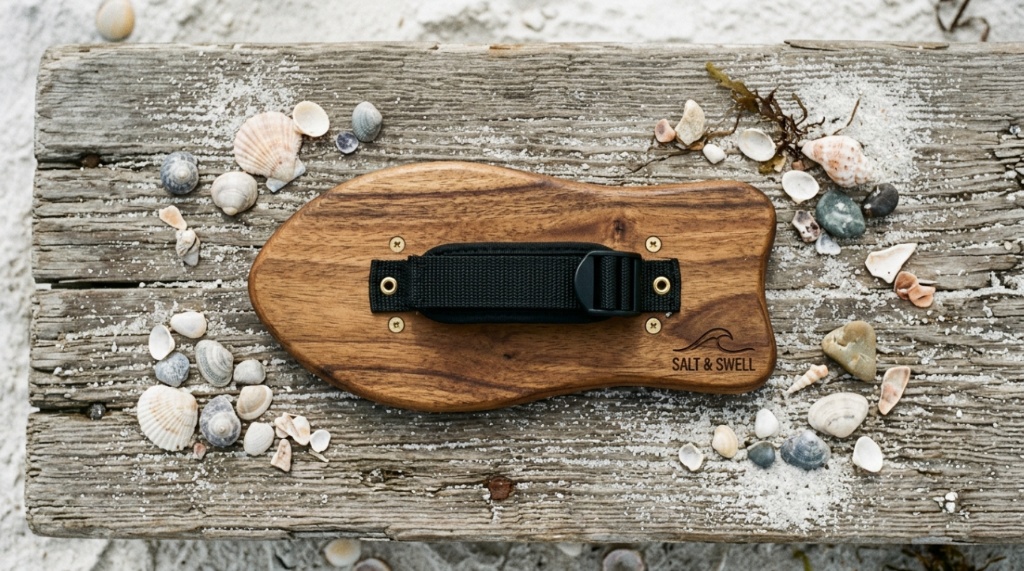
The tail of the handplane is what angles into the wave face. Because Florida waves are slow, you need a tail that creates lift as you lean forward. A square tail gives you a stable base, which is great for beginners. A swallowtail provides maneuverability but sacrifices speed. A release tail—common on high-aggression boards—creates fast pivot but is hard to control in underpowered waves.
For Florida, choose a square or slight swallowtail. Avoid the three-fin release tails unless you are an advanced bodysurfer tackling bigger hurricane swells. The square tail tracks well on the flatter face, giving you confidence to paddle into waves that break far outside.
Foam vs. Polycarbonate vs. Wood: Choosing Your Material
The material changes the sensation and durability of your handplane. Again, Florida’s heat and shallow sandbars dictate the best option.
| Material | Pros | Cons | Best For |
|---|---|---|---|
| High-Density Foam (PE) | Buoyant, quiet, flexible grip | Can compress after sandy sessions | Newbies, slow waves, Gulf Coast |
| Polycarbonate (Plastic) | Fast, durable, rigid | Slippery, noisy entry into water | Experienced swimmers, steep East Coast beach breaks |
| Wood (Paulownia) | Eco-friendly, stiff, beautiful | Expensive, requires extra care | Regulars who value craftsmanship |
| Fiberglass | Lightweight, durable, precision shape | Can break on impact with sandbars | Advanced performance in clean swells |
Due to the abrasive nature of Florida’s coral shell sand and frequent shallow water contacts, polycarbonate is often the most practical daily driver. It won’t absorb scent or warp in the heat, and it slides over sandbars without causing the wear you’d see on foam. However, if you prioritize a quiet, smooth drop-in, foam wins,Looking to upgrade your desktop setup after a long day riding waves? Get an Ergonomic Mouse Under $50 in Ohio to prevent wrist strain while working remotely.
Which Handplane Is Best for Experienced Florida Bodysurfers?
Experienced wave riders tend to prefer a board with a more defined rail. This isn’t about aesthetics; the rail edge grip allows you to disengage the water when transitioning from top to bottom of the wave.
Look for a board with hydro-dynamic rail channels. These are small indentations along the sides of the planing surface that redirect water flow and create suction to the wave face. It feels similar to a surfboard rail. In Florida’s often bumpy conditions, this keeps you locked in.
For strength, look for a board with a slightly longer nose (over 11 inches). This gives you more reach in the water when you take off late on steep walls. Length gives you leverage.
Common Mistakes to Avoid When Buying
Manufacturers often list dimensions like “Large” or “XL,” but these are inconsistent across brands. There are several errors that are repeated frequently when buying in Florida:
- Ignoring your wrist strength: A wide pad with a long nose requires wrist strength to hold the correct angle. If you get tired after five minutes, the board is too big.
- Getting a board with an angled deck: You want a flat deck for your palm. An angled deck—designed for down-the-line speed—is uncomfortable for most swimmers and causes cramping.
- Buying a model without drainage channels: In Florida’s afternoons, wind chop pushes water over the boards. Drainage holes help you regain speed faster after you submerge. This is a small but vital detail.
- Skipping the leash: In Florida current, losing your handplane is a real hazard. Unless you have a wrist leash comfortable enough to wear, choose a plastic board with a leash plug.
How to Test and Fine-Tune Your Handplane
Once you have narrowed your choices, you should conduct a pool or flat-water test before hitting a break. Get into the water and push your hand forward at a 30-degree angle. See if you can generate a “porpoising” glide without splashing too much.
If you feel the board dragging or vibrating, its tail is too sharp. This shape is creating suction. Try adjusting the angle of your wrist instead of buying a new board. Most times, adjusting your arm angle fixes the issue. If not, You can sand down the rails of a foam board carefully with 80-grit sandpaper to let it release water more easily, though this reduces buoyancy. With plastic boards, this modification is impossible, so you will need to buy the correct shape from the start. Use these practical steps to ensure your final choice meets your needs without needing constant adjustments.
Frequently Asked Questions
Can you use a boogie board hand plane in Florida waves?
Yes. Boogie board hand planes (sometimes called bodyboard handplanes) are compatible with Florida waves. They offer a greater surface area for easier wave catching. Their main downside is reduced turning ability when compared to a smaller handplane.
Is a handplane better than a handboard?
For Florida’s moderate conditions, a handplane is generally better. Handplanes provide more control and are easier on your shoulders. Handboards are larger and rely on heavy rail pressure to link turns, which is suitable for very steep, powerful breaks—rare in Florida.
How do you store a handplane in Florida heat?
Keep foam boards out of direct Sunlight when not in use. Temperatures over 120°F can warp the polyethylene. Rinse them with fresh water after use to avoid salt crystallization weakening the glue in straps. Store them flat, not in a hot car trunk.
How tight should the strap be on a handplane?
Tight enough that you cannot pull the board off your hand just by shaking it, but not so tight that it restricts blood flow. An ideal fit allows you to wiggle one finger, but the board remains stable during a paddle.
Do you use a leash?
Strongly consider it. In Florida, longshore currents can pull a released handplane away from you quickly. A coiled wrist leash prevents swims back to shore. However, a leash can catch on your arm during spins, so experienced riders often choose to swim without it.
Conclusion
Choosing the best bodysurfing handplane for Florida ultimately boils down to realism: assess the waves, disregard marketing hype, and prioritize lift over raw speed. Low rocker, about 10 inches long, and a secure strap system are your baseline. Materials are important, with foam offering buoyancy and plastic offering durability—so define your local break’s needs. By avoiding the common mistakes of incorrect sizing and aggressive rockers, you will be faster, more comfortable, and catch more waves. Start with a polycarbonate model, then graduate to a custom fiberglass shape once your style matures. Remember—each session on the towel and in the sea will refine your preference. Keep riding