If you live in Florida, you know the ocean is practically your backyard. But when the surf is flat, the wind dies down, or you simply can’t get to the beach, your core training doesn’t have to suffer. Balance boards have become a staple for surfers, skaters, and fitness enthusiasts across the Sunshine State because they build the kind of functional stability that machines simply can’t replicate. The problem is, most people stand on a board, wobble for thirty seconds, and call it a workout. That approach leaves serious gains on the table. This guide breaks down exactly how to train core strength with balance boards in FL, covering the specific muscles involved, the best exercises for real results, and how to progress safely.
Why Balance Boards Are Effective for Core Strength
Balance boards are not just about standing still. They create an unstable surface that forces your body to constantly recruit stabilizing muscles to keep you upright. Unlike a standard ab crunch or plank on solid ground, a balance board challenges your deep core muscles—the transversus abdominis, obliques, and multifidus—in a dynamic way. These are the muscles responsible for spinal stability, posture, and transferring force between your upper and lower body.
When you train on a balance board, you’re also engaging your proprioceptive system. This is your body’s ability to sense its position in space. In Florida, where many people transition between land sports and water sports, this type of training is invaluable. It mimics the shifting, unpredictable nature of standing on a surfboard or paddleboard, making it one of the most sport-specific conditioning tools available. If you are looking for the best equipment to get started, you can explore options for core strength with balance boards in fl to find a board that suits your skill level and goals.
The Difference Between Balance and Strength
It is important to distinguish between simply balancing and actually building strength. Balancing is a skill; strength is a physiological adaptation. If you just stand on a board while watching TV, you will improve your ankle stability and proprioception, but you won’t build significant core muscle. To build strength, you must add load, increase repetitions, or perform movements that require your core to work against resistance. This article focuses on the latter—turning a balance board into a legitimate strength-training tool.
Essential Core Exercises to Perform on a Balance Board
To get the most out of your balance board, you need a structured routine. The following exercises target different areas of the core, ensuring balanced development. Start with the basics and progress to the more advanced movements as your stability improves.
Balance Board Planks
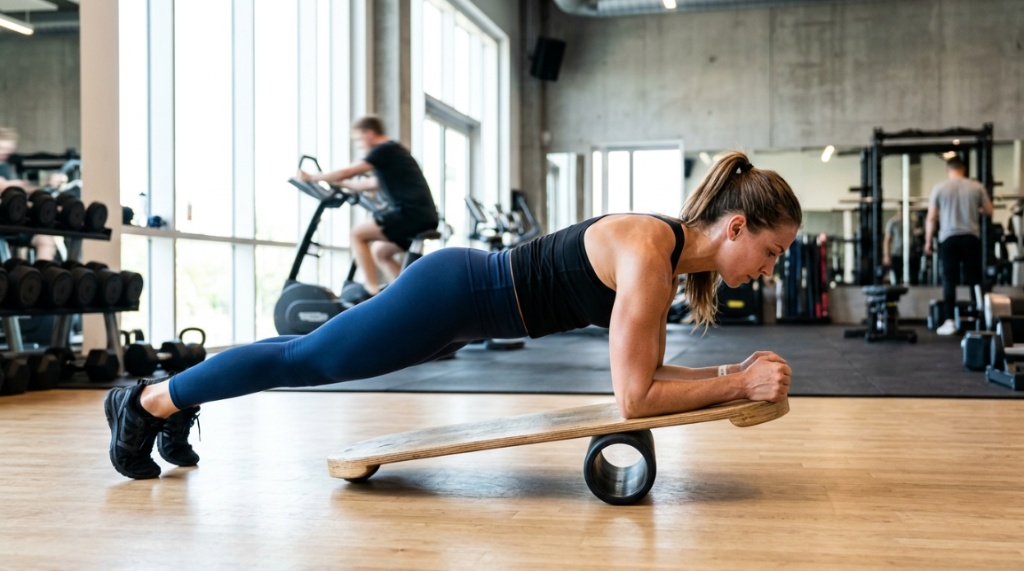
The standard plank is a great isometric exercise, but performing it with your hands or feet on a balance board takes it to another level. Place your forearms on the board and assume a plank position. Your body should form a straight line from your head to your heels. The instability of the board forces your serratus anterior, shoulders, and deep core muscles to fire continuously to prevent the board from tipping side to side.
How to progress: Hold for 30 seconds initially. As you get stronger, increase the time to 60 seconds or add a leg lift. Lift one foot a few inches off the ground while maintaining a stable pelvis. This shifts your center of gravity and forces your obliques to work harder to keep your hips level.
Bodyweight Squats on a Balance Board
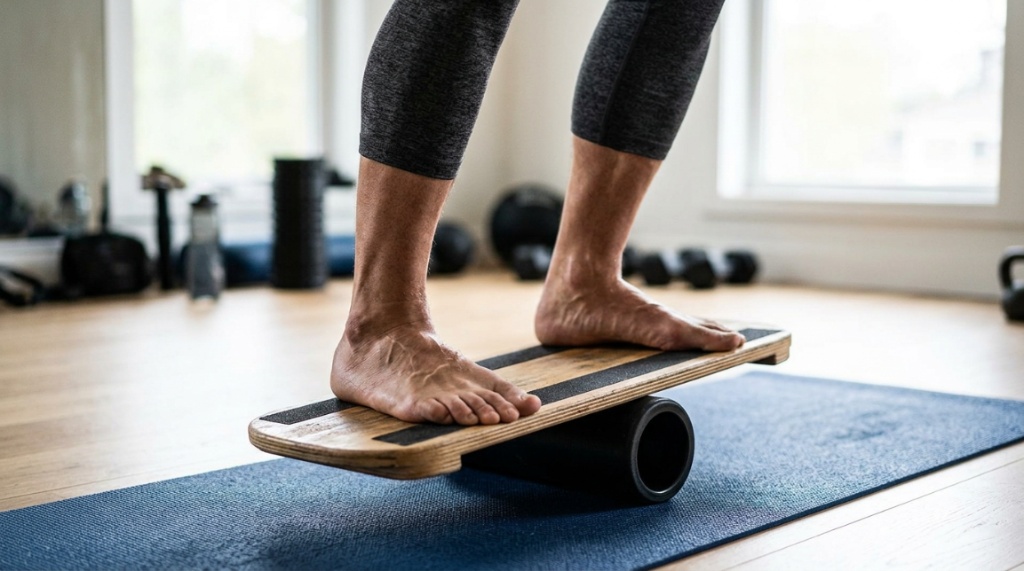
Squatting on an unstable surface is an excellent way to build core strength while also improving hip and ankle mobility. Stand on the board with your feet shoulder-width apart. Perform a controlled squat, pushing your hips back and bending your knees. The board will want to tilt, forcing your core to engage to keep the movement smooth and controlled.
Key coaching point: Do not rush the movement. The eccentric (lowering) phase should take about three seconds. This time under tension is what builds strength. If you find the board is wobbling excessively, focus on pressing your feet into the board as if you are trying to push the floor away from you, Looking to transition your balance skills from the gym to the open water? Make sure you have the right surfboard leash for safety and performance before catching your next wave.
Balance Board Push-Ups
Push-ups are a compound exercise that heavily recruits the core to maintain a rigid torso. When you place your hands on a balance board, you add a rotational stability challenge. As you lower your chest toward the board, your core must resist the urge to rotate or sag.
How to progress: Start with your knees on the floor if needed. Once you can perform 15 clean repetitions on your toes, try placing your feet on a second balance board or a stability ball. This increases the instability at the lower half of your body, forcing your core to work even harder to keep your spine aligned.
How to Structure a Balance Board Core Workout
Knowing the exercises is only half the battle. You need a plan. A well-structured workout should include a warm-up, the main exercises, and a cool-down. Here is a sample routine that you can perform three times a week, with at least one rest day between sessions.
- Warm-up (5 minutes): Start with light cardio like jumping jacks or a brisk walk. Then, spend two minutes on the balance board just finding your center of gravity. Shift your weight in circles, forward and back, and side to side.
- Main Set (20 minutes): Perform the following circuit. Rest for 60 seconds between rounds.
- Balance Board Planks: 3 sets of 45 seconds
- Bodyweight Squats: 3 sets of 12 repetitions
- Balance Board Push-Ups: 3 sets of 10 repetitions
- Cool-down (5 minutes): Step off the board and perform static stretches for your hips, hamstrings, and lower back.
Adding Resistance for Advanced Strength
Once bodyweight exercises become easy, you need to add external load to continue building strength. Holding a dumbbell or a medicine ball during your squats is a simple way to increase the intensity. For planks, you can wear a weighted vest. For rotational exercises, use a resistance band anchored to a sturdy post. The key is to keep the load light enough that you can maintain control. If your form breaks down, the weight is too heavy.
Common Mistakes to Avoid When Training with Balance Boards
Many people make avoidable errors that limit their progress or lead to injury. Being aware of these pitfalls will help you train smarter.
- Looking down at your feet: This throws off your spinal alignment. Keep your head neutral and your eyes focused on a fixed point on the wall in front of you.
- Holding your breath: Your core needs oxygen to work. Exhale on the exertion phase of the movement and inhale during the relaxation phase.
- Training on a soft surface: Using a balance board on a carpet or mat reduces the instability. For the best results, use it on a hard, flat floor where you have a safe area to step off if you lose your balance.
- Ignoring ankle strength: Your core works in tandem with your ankles. If your ankles are weak, your core will overcompensate. Incorporate calf raises and ankle circles into your routine.
Choosing the Right Balance Board for Your Goals
Not all balance boards are created equal. The type of board you choose will significantly impact your training. There are two main categories: rocker boards and wobble boards.
| Feature | Rocker Board | Wobble Board |
|---|---|---|
| Movement | Rocks side-to-side or front-to-back | Tilts in all directions (360 degrees) |
| Difficulty | Easier to control; good for beginners | More challenging; requires more ankle and core stability |
| Best For | Surf training, lateral movements, push-ups | Rehabilitation, general balance, rotational strength |
| Core Activation | Targets obliques and lateral stabilizers | Targets deep core muscles and hip stabilizers |
If you are training specifically for surfing, a rocker board is often more beneficial because it mimics the rail-to-rail movement of riding a wave. If your goal is general athleticism or injury prevention, a wobble board offers a more comprehensive challenge. Consider your primary objective before making a purchase.
Safety Considerations and Limitations
Balance board training is highly effective, but it is not without risks. The most common issue is falling. Always ensure you have a clear space around you, free of furniture with sharp corners. It is also wise to have a wall or a sturdy chair nearby to hold onto when you are first starting out.
Individuals with existing ankle, knee, or lower back injuries should consult a physical therapist before incorporating balance boards into their routine. While the instability can help strengthen weak stabilizers, it can also aggravate acute injuries. Start with short sessions of 5–10 minutes to allow your joints and connective tissues to adapt to the new stress.
Frequently Asked Questions
How often should I use a balance board for core strength?
For optimal results, aim for three sessions per week. Your core muscles, like any other muscle group, need time to recover and rebuild. Training every day can lead to overuse injuries and fatigue, which increases your risk of falling.
Can balance boards replace traditional core exercises like crunches?
Balance boards are an excellent addition to your routine, but they should not completely replace all core exercises. They excel at building stability and endurance, but they are less effective at building raw strength and hypertrophy. For a complete core program, combine balance board work with weighted exercises like cable rotations and hanging leg raises.
How long does it take to see results from balance board training?
Most people notice improved balance and stability within two to three weeks of consistent practice. Visible changes in core muscle definition typically take longer, usually around six to eight weeks, depending on your diet and overall training program.
Is a balance board good for back pain?
Balance boards can be beneficial for mild, chronic lower back pain by strengthening the deep core muscles that support the spine. However, if you have acute back pain or a herniated disc, you should avoid using a balance board until a medical professional clears you.
Do I need to be an athlete to use a balance board?
No. Balance boards are scalable to any fitness level. Beginners can start by simply sitting on the board or holding onto a wall while standing. As your confidence and stability grow, you can progress to more challenging exercises without any external support.
Conclusion
Training core strength with balance boards in FL offers a unique and highly effective way to build functional stability that translates directly to sports and daily life. By moving beyond simple balancing and incorporating exercises like planks, squats, and push-ups, you can transform your core into a powerful foundation. Remember to choose the right board for your goals, focus on controlled movements, and avoid the common mistakes that lead to injury. Start with the basic routine outlined here, progress gradually, and you will notice a significant improvement in your balance, posture, and overall athletic performance.