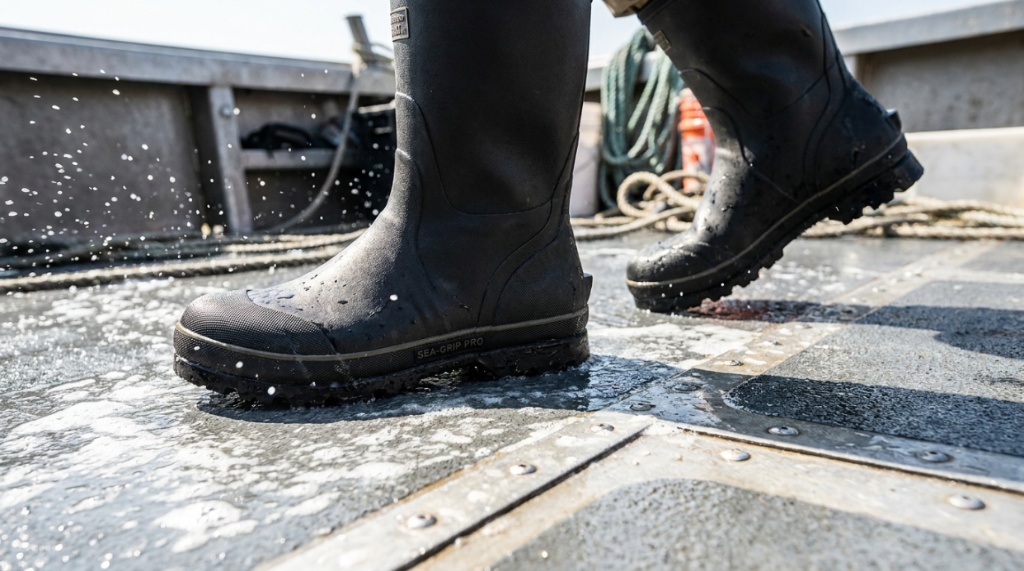
Commercial fishing remains the second most dangerous occupation in America — and recreational anglers face the same wet-deck physics without the safety training, equipment, or experience that professionals rely on to stay alive. Staying safe on slippery boat decks starts with choosing the right fishing deck boots engineered specifically for the treacherous combination of smooth fiberglass, saltwater film, fish slime, and unpredictable boat movement. Fishing deck boots are ankle-height or taller waterproof boots with specialized non-slip outsoles designed to maintain traction on wet boat deck surfaces under the dynamic conditions of marine environments. The frightening reality? A wet fiberglass boat deck has a friction coefficient comparable to ice when covered with a thin water film — and standard footwear responds to this surface with the same helplessness your car tires show on black ice. One wave splash, one misplaced step in fish blood, one aggressive hook-set while off-balance — and gravity wins instantly. This guide covers everything needed to maintain safety through proper non-slip fishing shoes selection, deck maintenance, and movement habits that prevent the falls responsible for thousands of boating injuries annually.
What Makes Boat Decks So Dangerously Slippery?
Boat decks become dangerously slippery because their smooth gelcoat or painted surfaces create near-zero friction when covered by the thin water film that’s essentially unavoidable during any fishing activity.
The physics of boat deck danger:
- Surface smoothness: Fiberglass gelcoat is intentionally smooth for hull hydrodynamics. Walking surfaces share this smoothness — they’re not textured like sidewalks or roads because texturing complicates boat manufacturing and cleaning.
- Water film (hydroplaning): Even 0.5mm of water on a smooth surface eliminates friction between your sole and the deck. Your shoe rides the water layer, never contacting the deck directly — identical to aquaplaning at highway speeds.
- Fish slime and blood: Organic lubricants from caught fish reduce friction far beyond water alone. Fish slime on a wet deck approaches near-zero friction — more slippery than wet deck alone.
- Sunscreen and oils: SPF products transfer from hands and skin to deck surfaces, creating invisible lubricating films that persist until scrubbed away.
- Salt crystal residue: Dried saltwater leaves microscopic crystals that become lubricating granules when re-wetted — rolling under your feet like tiny ball bearings.
- Dynamic boat movement: The deck itself moves — pitching, rolling, yawing — creating forces your body wasn’t braced for. A surface that feels manageable at anchor becomes dangerous at speed or in waves because forces change direction continuously.
Combined, these factors create conditions where even athletic, sure-footed individuals fall without warning. The danger isn’t about balance ability — it’s about physics that overwhelm human reflexes regardless of fitness level.
How Do Non-Slip Deck Boots Overcome These Hazards?
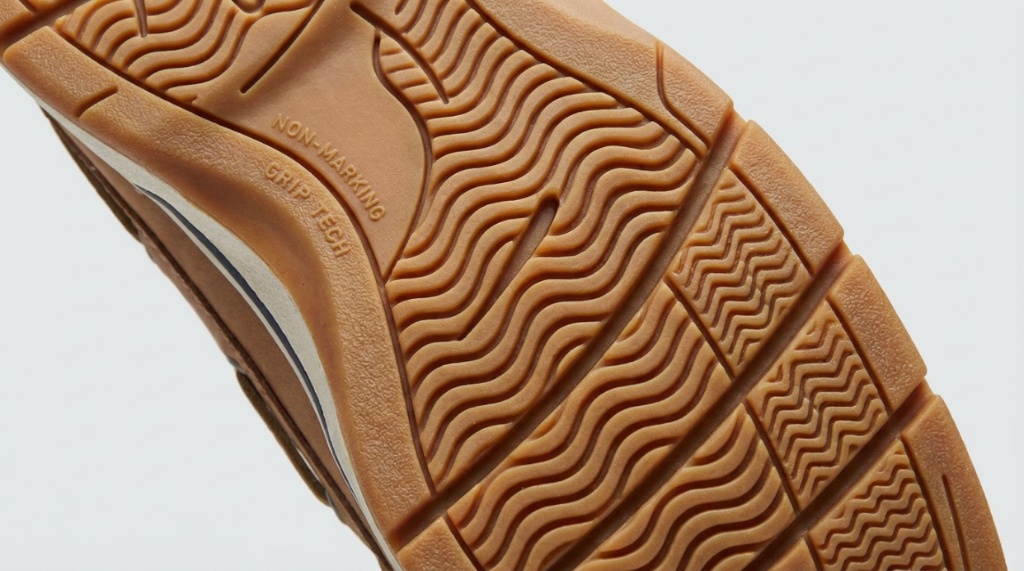
Non-slip deck boots overcome wet-deck physics through three mechanisms: siped rubber that creates micro-suction by evacuating the water film, soft compounds that generate molecular adhesion against smooth surfaces, and wide contact areas that distribute force for maximum friction surface.
How each mechanism contributes to safety:
- Siping mechanism: Hundreds of thin channels cut into the rubber compress under your body weight, squeezing water out from the sole-to-deck interface. This creates direct rubber-to-deck contact (not rubber-to-water-to-deck) — restoring friction that the water film eliminated. Think of it as your shoe’s tire tread, designed specifically for the water film thickness found on boat decks.
- Soft compound adhesion: Rubber formulated at durometer 50–65 (vs. 75+ in standard shoes) deforms at microscopic level to match surface irregularities invisible to the eye. This surface-matching creates Van der Waals force adhesion — the same physics that let geckos climb smooth walls. It’s not dramatic grip you can feel — it’s molecular-level friction that prevents the sudden release standard rubber experiences on wet smooth surfaces.
- Contact area maximization: Flat-bottomed designs with minimal heel elevation place maximum rubber surface against the deck. More contact area = more friction force = more resistance to sliding. Raised heels, narrow soles, or aggressive lugs all reduce effective contact area on flat surfaces.
Real-world performance: a quality non-slip deck boot converts a wet fiberglass surface from “ice-equivalent” (friction coefficient ~0.05) to “wet-rubber-on-deck” (friction coefficient ~0.35–0.50). This 7–10x improvement in friction is the difference between confident footing and emergency room visits.
What Height Deck Boot Provides the Best Protection?
Ankle-height (6-inch) deck boots provide the best balance of protection and mobility for most recreational fishing — covering the ankle from spray and impacts while maintaining the freedom of movement needed for active fishing, casting, and deck navigation.
Boot height comparison:
| Boot Height | Protection Level | Mobility | Weight | Best For |
|---|---|---|---|---|
| Low-cut shoe (under 4″) | Moderate — exposes ankle | Excellent | Light (12–18 oz) | Calm inshore, flats, warm conditions |
| Ankle boot (6″) | Good — covers ankle joint | Very good | Moderate (18–28 oz) | Most recreational fishing, charter trips |
| Mid-calf (12″) | Very good — protects lower leg | Moderate | Heavy (28–40 oz) | Rough offshore, frequent deck flooding |
| Knee-high (15″+) | Maximum — full lower leg coverage | Reduced | Heavy (40–56 oz) | Commercial fishing, extreme conditions |
For most recreational anglers and charter fishing clients, the ankle-height boot (6 inches) hits the optimal balance. It prevents wave spray from entering above the shoe line (a constant problem with low-cut shoes on boats with any chop), protects the ankle bone from impact with deck hardware, and provides mild ankle support for stability — without the weight, heat, and restricted movement of taller boots.
When to go higher: offshore trips in 3+ foot seas, overnight trips where conditions may deteriorate, winter fishing with spray that creates numbing cold, and any situation where deck flooding is routine rather than occasional.
How Should You Move on a Wet Boat Deck to Stay Safe?
Move on wet boat decks with short shuffling steps (never long strides), maintain constant three-point contact with the boat (two feet + one hand), keep your center of gravity low by slightly bending your knees, and always face the direction of boat movement.
Safe movement principles for wet decks:
- Short steps: Long strides shift your center of gravity far from your base — if the foot you’re stepping toward slips, you have no recovery option. Short shuffling steps keep your weight centered over your support foot at all times. Think of how you’d walk on ice — apply the same caution.
- Three-point contact: Always have one hand on a grab rail, gunwale, T-top support, or stable structure while moving. This means you move slowly — but a hand contact gives you instant recovery ability if a foot slips.
- Bent knees: Slightly flexed legs lower your center of gravity and allow your body to absorb unexpected boat movement without losing balance. Locked, straight legs transfer every deck vibration and wave impact directly to your upper body.
- Face the motion: When the boat is moving, face forward (or whichever direction the dominant motion vector travels). Your body handles forward/backward forces far better than lateral forces. Unexpected lateral force while facing sideways is the most common fall-trigger on boats.
- One hand for you, one hand for the ship: Old maritime wisdom. Always keep one hand free for grabbing support. Carrying heavy items (coolers, tackle boxes) with both hands while moving on a wet deck eliminates your recovery option. Make two trips.
Even with perfect non-slip boots, these habits matter. Boots provide the foundation of safety — but safe movement techniques build upon that foundation for comprehensive fall prevention.
What Deck Maintenance Improves Footwear Safety?
Regular deck cleaning removes fish slime, sunscreen residue, and salt crystal buildup that reduce traction even for non-slip boots — maintaining the deck surface’s own contribution to your footwear’s grip system.
Deck maintenance for safety:
- Between catches: Rinse fish blood and slime from the deck immediately with a bucket of seawater. Fish slime is the most dangerous substance on a boat deck — more slippery than water alone by a significant margin. Don’t let it dry or spread.
- Throughout the day: Rinse deck areas where you stand most frequently (fighting chair, rod holders, cooler access) every 1–2 hours. Salt spray dries and re-activates into lubricating crystals with the next splash.
- After sunscreen application: Wash hands thoroughly before touching deck surfaces, rails, or rod grips. SPF products are hydrocarbon-based — they create invisible oil films that persist on deck surfaces and reduce traction significantly.
- End of trip: Full deck washdown with freshwater removes all organic and salt residue. This prevents buildup that accumulates trip-over-trip, creating progressively more dangerous surfaces.
- Non-skid maintenance: Most boats have textured non-skid surfaces in walkways. These lose effectiveness when worn smooth by foot traffic. Check non-skid areas annually — re-apply non-skid coating or textured paint when original texture becomes smooth.
Think of deck maintenance as supporting your footwear investment. The best non-slip boots in the world work against the surface they contact — if that surface is contaminated with slime and oil, even premium soles face degraded conditions. Maintain both sides of the grip equation: shoes AND surface.
What Additional Safety Equipment Complements Proper Footwear?
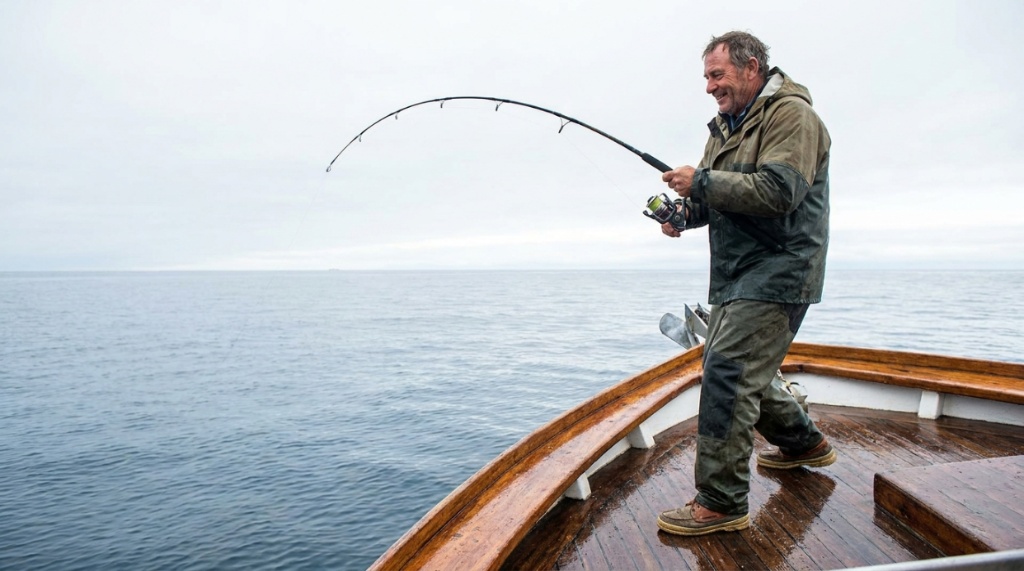
Proper non-slip footwear is your primary defense against deck falls — but grab rails, life jackets, deck lighting for night fishing, and situational awareness habits provide layered safety that reduces both fall probability and fall consequences.
Complementary safety layers:
- Grab rails and hand holds: Ensure your boat has grab rails along all walkways and near all fishing positions. If rails are absent, install aftermarket T-top grabs, rod holder supports, or strategic hand holds. You can’t maintain three-point contact if contact points don’t exist.
- Life jacket (always): If a fall takes you overboard, your fishing shoes become irrelevant — your life jacket determines survival. Wear it. Auto-inflate models provide protection without the bulk that traditional foam jackets create. Consider them complementary to footwear safety, not alternative.
- Deck lighting (night fishing): You can’t avoid hazards you can’t see. LED deck lights illuminate trip hazards, slippery patches, and movement paths. Red lights preserve night vision while providing enough visibility for safe navigation.
- Non-skid deck mats: Aftermarket adhesive non-skid pads applied to high-traffic areas (helm, fighting position, cooler access) provide additional traction layer that works with your boots’ grip technology. Particularly valuable on older boats with worn original non-skid.
- Kill switch/engine cutoff: If you fall near the helm and the boat is in gear, an engine cutoff device prevents the boat from circling back over you. Always wear it when operating at speed.
How Often Should You Replace Deck Boots for Safety?
Replace deck boots when outsole siping is less than 50% of original depth, when rubber compound has visibly hardened (lighter color, less flexible), or when grip performance noticeably decreases on wet surfaces — typically every 12–24 months for regular anglers.
Replacement indicators you can physically check:
- Siping depth test: Compare your current boot soles to a new boot from the same brand (visit a store or check product photos). If your sipe channels are less than half the depth of new soles, grip performance has degraded significantly.
- Color change: Rubber compounds that have UV-degraded often lighten in color compared to original. This color change correlates with hardening — which directly reduces wet-surface grip.
- Flexibility test: Flex the sole. Fresh rubber bends easily with visible sipe channels opening during flex. Degraded rubber resists bending and sipe channels stay closed during flex — indicating the channels won’t activate effectively under foot pressure either.
- Wet performance test: If you notice decreased confidence on wet surfaces where you previously felt secure — that perception is accurate. Trust your feet’s feedback over visual assessment. Functional grip degradation is felt before it’s visible.
Replacement timeline by usage:
- Heavy use (4+ trips weekly): Replace every 8–12 months
- Regular use (1–3 trips weekly): Replace every 12–18 months
- Moderate use (2–4 trips monthly): Replace every 18–24 months
- Light use (monthly or less): Replace every 24–36 months (UV degradation still occurs during storage)
When you are battling a heavy fish in rough conditions, keeping your footing is only half the challenge—you also need gear that can handle the pressure. While upgrading your footwear ensures you stay stable on wet surfaces, pairing that stability with a reliable rod and reel setup makes all the difference. If you are looking to upgrade your gear without breaking the bank, pairing your new deck footwear with the[Best Fishing Combos Under $100 will give you a tournament-ready setup that keeps you safe, stable, and ready to hook your next catch.
Conclusion
Boat deck safety isn’t a single-solution problem — it’s a system built from proper non-slip footwear as the foundation, safe movement habits as the framework, deck maintenance as the support structure, and additional safety equipment as the backup layers. Fishing deck boots with proper siping, soft rubber compounds, and adequate height provide the critical grip that transforms dangerous wet fiberglass from an injury trap into a manageable working surface.
But shoes alone aren’t enough. Move deliberately. Maintain three-point contact. Keep decks clean of slime and oil. Replace boots before grip degrades below safe thresholds. Wear your life jacket for the falls that prevention can’t eliminate. The ocean doesn’t forgive carelessness, and boat decks don’t warn you before they become frictionless. Prepare comprehensively, and every trip returns you safely to the dock — which is the only outcome that matters more than the catch.
Frequently Asked Questions
What’s the safest boot material for wet boat decks?
Soft rubber (durometer 50–65) with heavy siping provides the safest wet-deck performance. Full rubber boot construction (XTRATUF, Grundéns) delivers this across the entire sole surface without the grip inconsistencies that multi-material soles sometimes create at material transition points. Rubber boots also eliminate water entry completely — maintaining consistent internal conditions regardless of deck flooding.
Are there specific boots recommended for charter fishing guests?
XTRATUF 6-inch Ankle Deck Boots are the most commonly recommended for charter guests — they’re affordable ($70–$100), provide excellent grip, pull on quickly without lacing, and come in sizes that fit most feet without precise fitting. Many charter boats keep a set of communal XTRATUF boots in various sizes for guests who arrive with inadequate footwear.
Can I add non-slip features to regular boots?
Aftermarket grip products exist (spray-on rubber coatings, adhesive sole pads) but provide significantly inferior performance compared to purpose-built non-slip soles. The grip from a proper siped fishing boot cannot be replicated by surface treatments — the engineering is integral to the sole design, not a surface addition. For safety-critical applications like boat decks, invest in proper footwear rather than modifying inappropriate shoes.
How do I stay safe if I forget proper fishing shoes?
If stuck on a boat with inadequate footwear: minimize movement, maintain hand contact with stable structures at all times, avoid areas with visible water/slime, ask the captain to rinse your path before you walk, and stay seated whenever possible. Bare feet actually provide better grip than some standard shoes on wet fiberglass (skin friction exceeds hard rubber friction) — but expose you to hook, heat, and impact hazards. There is no perfect solution for forgotten footwear beyond extreme caution.
Do non-slip boot covers or overshoes work as an alternative?
Slip-over non-skid covers (rubber over-boots worn over regular shoes) provide moderate improvement over bare shoe soles — but significantly underperform dedicated non-slip boots because the additional layer creates instability between your foot and the gripping surface. They’re an acceptable emergency backup but not a substitute for proper fishing deck boots during planned trips.
What’s the most common injury from boat deck falls?
Wrist fractures from bracing against falls, followed by head/face injuries from hitting deck hardware (cleats, rod holders, console edges), and rib fractures from landing on gunwales. Severe cases include overboard falls resulting in drowning or propeller contact. The severity range — from bruised pride to fatality — makes prevention through proper footwear and movement habits a non-negotiable aspect of fishing safety rather than optional comfort preference.