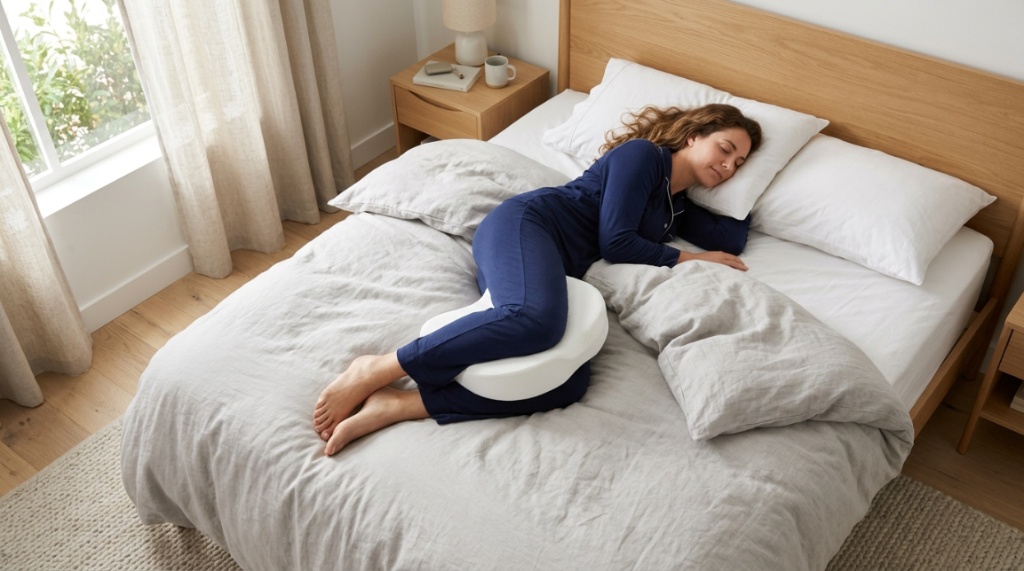
Waking up with a dull ache in your hip or feeling that sharp pinch every time you roll over in bed can turn a good night’s sleep into a nightly battle. If you’re a side sleeper, the problem is often alignment—or rather, the lack of it. You might have tried adjusting your legs, stacking regular pillows, or simply toughing it out, but the pain persists. This is where a specialized knee pillow for hip pain comes into play. It’s not just a soft accessory; it’s a biomechanical tool designed to realign your spine and pelvis. In this guide, we will walk you through exactly how to position it, why it works, and how to choose the right one to finally get the restful sleep your body is craving.
Why Does Hip Pain Worsen at Night for Side Sleepers?
For side sleepers, the primary culprit behind night-time hip pain is the unnatural twisting of the pelvis. When you lie on your side without support, your top leg falls forward, dragging your pelvis into a rotated position. This pulls on the hip joint and the surrounding muscles, including the glutes and the piriformis, leading to stiffness and pain by morning. Essentially, you are placing unnecessary strain on a joint that is meant to stay stacked and aligned.
The Anatomical Misalignment Problem
Think of your spine as a straight line from your neck to your tailbone. When you sleep on your side with your top leg hanging limply, the femur (thigh bone) drops inward, rotating the pelvis. This creates a “twist” in the lumbar spine and forces the hip joint into an extreme range of motion. Over time, this habitual misalignment can aggravate conditions like bursitis or sciatica.
Why Regular Pillows Fail to Fix It
Most people try stacking a standard bed pillow between their knees. While this provides some space, standard pillows are often too thick or too soft. A thick pillow misaligns the hips by pushing the top leg too high, while a thin, lumpy pillow collapses instantly, offering zero support. To effectively relieve hip pain, you need a tool with the right density and height to keep the femur bone perfectly parallel to the floor.
The Role of the “Knee Gap”
The secret to hip relief lies in maintaining the “knee gap.” This is the distance between your knees when lying on your side. The correct height of a pillow fills this gap completely, keeping your top thigh level with your bottom thigh. This neutral alignment prevents pelvic rotation and allows the hip joint to rest in its natural socket, reducing inflammation and pressure points.
What Is the Correct Way to Position a Knee Pillow?
Positioning is everything. Simply shoving a pillow between your knees won’t yield results. The correct placement requires aligning the pillow with your thighs, not just your knees. The goal is to support the entire length of your upper leg to distribute pressure evenly and maintain a stacked hip position.
Step-by-Step Guide to Lying Down
- Lie on your back first: Start by sitting on the edge of your bed and lie down on your back. This helps you center your spine.
- Roll to your side: Gently roll onto your unaffected side (the side without pain, if applicable). Bend your knees slightly toward your chest.
- Place the pillow: Position the knee pillow so it sits between your knees, but crucially, extend it upward so it also rests slightly against your inner thighs. Avoid placing it only at the kneecaps.
- Adjust the height: Ensure your top hip feels “stacked” directly above the bottom hip. If your top hip feels like it’s dipping down, your pillow is too low or too soft. If it feels pushed up, it’s too high.
- Check your spine: Have someone look at your back (or feel your spine) to ensure it forms a straight line from your neck to your tailbone. No curve should dip into the mattress.
Common Positioning Mistakes to Avoid
One of the most frequent errors is placing the pillow only between the bony parts of the knees. This creates a hinge effect where the feet and thighs still touch, negating the benefits. Another mistake is hugging the pillow while sleeping, which twists your shoulder and ribs, inadvertently pulling on the hip. Always keep the pillow strictly between your legs, from knee to mid-thigh.
Adjusting for Different Body Types
Your body weight and thigh circumference determine how much “squish” you need. Petite individuals may find a low-profile contoured pillow more effective, while larger individuals need a firm, taller pillow to prevent the top leg from sagging. Always check the compression rate—the pillow should compress no more than 20% under your leg weight.
Which Types of Knee Pillows Are Best for Hip Pain?
Not all knee pillows are created equal. The best type for hip pain is typically a contoured foam pillow that features an ergonomic “wave” shape—one side is thicker to accommodate the leg, with a strap to keep it in place. Memory foam is often the gold standard because it molds to your leg shape without pushing back, offering a customized fit.
Memory Foam vs. Polyester Fiber
Memory foam offers superior pressure relief because it is viscoelastic, meaning it slowly conforms to your body heat and weight. This prevents hard pressure points on the inner knee. Polyester or fiberfill pillows are fluffier but lack the structural integrity to stay in place all night. They tend to flatten out, allowing the knees to touch and the pelvis to rotate again.
Contoured vs. Flat Pillows
A contoured pillow with a raised center and a strap is specifically engineered to lock your leg into the correct position. The strap prevents the pillow from sliding away when you toss and turn. A flat pillow, even if thick, offers no lateral stability. For chronic hip pain, a contoured design with a strap is almost always recommended.
Cooling Materials and Adjustable Fill
If you tend to sleep hot, look for pillows with gel-infused foam or breathable covers. Some advanced models feature an adjustable fill layer, allowing you to remove or add stuffing to change the loft. This is incredibly useful for people who experience fluctuating weight or who need a custom height to align their specific hip width. A great resource for comparing top-rated, budget-friendly options is this detailed selection of the best affordable knee pillow for hip pain solutions on the market.
How Does Using a Knee Pillow Actually Relieve Hip Pain?
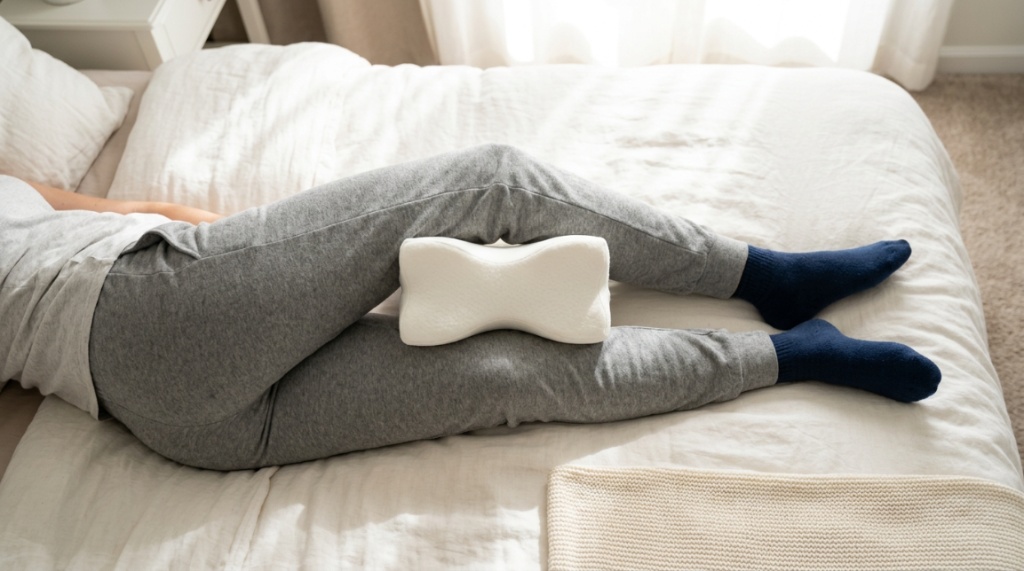
A knee pillow relieves hip pain by mechanically reducing stress on the hip joint. It prevents the top leg from pulling on the pelvis, which stops the rotation. This allows the joint capsule to relax, reduces pressure on the sciatic nerve, and improves circulation to the area. The result is a reduction in inflammation and a significant decrease in morning stiffness.
The Biomechanics of Pelvic Neutrality
When your pelvis is neutral, your hip joints are in a “zero position” — facing straight forward without rotation. This maximizes the joint space, preventing the cartilage from rubbing against the joint rim. By maintaining this neutral position for 7-8 hours, you allow the synovial fluid to lubricate the joint properly and the muscles to relax instead of spasming.
Reducing Pressure on the Sciatic Nerve
Many hip pain cases are actually referred pain from the sciatic nerve. When the piriformis muscle (located in the buttocks) becomes tight from pelvic rotation, it presses on the sciatic nerve. Keeping the knees apart with a pillow relieves tension in the piriformis, allowing it to lengthen and release the nerve. This dramatically reduces pain that radiates down the back of the leg.
Improving Blood Circulation and Healing
Prolonged compression on the small blood vessels in the hip can cause ischemia (lack of blood flow), leading to sharp pain. Elevating the top leg slightly with a pillow takes the body weight off the bottom hip’s bursa sac, allowing for healthy blood flow. This micro-circulation is essential for tissue repair and reducing night-time aches.
Can a Knee Pillow Help with Back Pain and Posture?
Yes, absolutely. While the primary focus is often hip pain, the spine is one continuous structure. When the hips are misaligned, the lower back compensates by curving. A knee pillow corrects this pelvic tilt, which in turn flattens the lower back into a more neutral position. This prevents the “hammock” effect on the spine and reduces lower back strain.
Preventing the “Swayback” Position
Without a knee pillow, the top leg rotates forward, which pulls the pelvis into an anterior tilt. This arching of the lower back is known as “swayback.” This position places immense pressure on the lumbar discs. Using a knee pillow keeps the legs parallel, which flips the pelvis into a posterior tilt, flattening the back and relieving disc pressure.
Aligning the Entire Skeletal System
Proper hip alignment also affects your neck and shoulder. If your hips are twisted, your torso will twist to compensate, which forces your neck to rotate to keep your head level. This can lead to a stiff neck and headaches. By aligning the foundation (the hips), you naturally align the entire kinetic chain above it.
The Connection Between Hip Flexors and Posture
Tight hip flexors (the muscles on the front of the hip) pull your body into a forward-leaning posture. Sleeping without a knee pillow shortens these muscles overnight. By keeping the hip in a neutral, elongated position with a pillow, you keep the hip flexors stretched and loose, improving your standing posture and reducing upper back strain the next day.
When Should You Use a Knee Pillow vs. Other Sleep Positions?
If you have hip pain, you should use a knee pillow whenever you sleep on your side—even if you only doze off in that position for a few hours. However, if you have a torn rotator cuff or severe shoulder issues, sleeping on your side may not be possible. In that case, a knee pillow can still be used while lying on your back to maintain lumbar support.
Side Sleeping with Hip Pain
This is the primary use case. If you are a strict side sleeper, the knee pillow is non-negotiable. It is the only way to prevent the top leg from sagging. Use a pillow height that matches the distance from your upper hip to the bed surface. Always place the pillow against the full thigh, not just the knee joint.
Back Sleeping with a Hip Support Alternative
For back sleepers, a knee pillow serves a different purpose. Placing the knee pillow under your knees (behind the knees) gently flexes the hip and lower back, reducing pressure on the sciatic nerve and relieving hip strain. It works differently, but it’s still beneficial for hip pain, especially if you suffer from a herniated disc.
Stomach Sleeping: Why You Should Avoid It
Stomach sleeping is the worst position for hip pain because it rotates the pelvis and strains the lower back. If you cannot change this position, place a very thin knee pillow under your front hip slightly to reduce the angle. However, the long-term goal should be to transition to side sleeping with a proper knee pillow to resolve the pain.
How to Choose the Right Firmness and Height for Your Knee Pillow
Choosing the right firmness is a balance between cushioning and support. The pillow should be soft enough to prevent pressure on the inner knee bones but firm enough that your leg doesn’t sink to the bed. A good rule of thumb is that the pillow should compress by about 1 to 1.5 inches when your leg is resting on it.
The “Hip Alignment” Test
To test if your pillow has the correct height, stand up and place the pillow between your legs. If the top of the pillow is higher than your hip joint, it’s too tall. If it’s lower, it’s too short. In bed, you can test by looking at the dip in your waist—there shouldn’t be a sharp curve indicating your leg is pulling down.
Firmness Guide: Soft, Medium, or Hard?
- Soft (Low density foam): Best for light sleepers or those with sensitive knees, but often lacks support for heavier legs.
- Medium (Memory foam standard): The sweet spot for most people. It provides enough resistance to support the leg while contouring to the skin.
- High (Supportive foam): Recommended for larger body types or those with severe pelvic tilt who need maximum lift.
The Importance of the Strap
A strap is not just a gimmick; it is a functional necessity. The strap helps hold the pillow in place, preventing “pillow drift” during the night. Without a strap, you’ll likely wake up with the pillow on the floor or stuck between your ankles, leaving your knees unsupported. Look for an adjustable strap made of soft, stretchy material that won’t irritate your skin.
Can Using a Knee Pillow Worsen Existing Hip Pain?
While rare, using a knee pillow incorrectly can exacerbate pain. If the pillow is too high, it can over-stretch the hip ligaments, causing a different type of pain. If it’s too hard, it can compress the peroneal nerve on the outer side of the knee. It is crucial to listen to your body and adjust the position,Proper spinal alignment is essential for a restorative night’s rest, especially if you wake up with joint discomfort. For more tips, read our guide on how to reduce hip pain while sleeping with a contour knee pillow to instantly improve your sleeping posture.
Signs You Are Using the Wrong Pillow
If you wake up with numbness in your foot or tingling in your leg, the pillow is likely pressing against a nerve. If your hip pain is localized on the outer side of the hip (the bursa), your pillow might be too thick, causing over-lengthening. Conversely, if the pain is in the front of the hip (the groin), you likely need a thicker pillow to stop the leg from twisting inward.
Adjusting for Acute Injuries
If you have an acute hip injury, such as a labral tear or severe bursitis, you may need a lower-profile pillow and to place a second pillow under your lower leg for extra support. Always consult with a physical therapist if the pain persists for more than two weeks despite using the pillow correctly.
Transitioning to No Pillow
Once the pain subsides, you might be tempted to ditch the pillow. However, keep using it. Many people find that stopping the use of the knee pillow causes the pain to return within nights, as the muscle memory of twisting returns. Consistency is key to retraining your sleeping posture.
How Long Does It Take to See Results with a Knee Pillow?
Most users notice a dramatic reduction in hip pain within the very first night. The majority of pain relief is immediate because the pillow mechanically eliminates the strain. However, for chronic conditions like sciatica or bursitis, it might take up to 7-10 days of consistent use to allow the inflamed tissue to heal and the pain to fully dissipate.
Immediate Relief vs. Long-Term Correction
Immediately, the pillow provides a feeling of “opening” in the hip joint. Long-term, it allows the hip capsule to regain its full range of motion and the muscles to rebalance. It’s a passive therapy that works while you sleep, making it one of the easiest physical adjustments you can make.
Complementary Stretches for Faster Relief
For optimal results, combine the pillow with daily stretches. The “pigeon stretch” and “figure-four stretch” are excellent for opening the hip externally. Doing these for 2 minutes before bed will relax the muscles so the knee pillow can maintain the stretch throughout the night, speeding up recovery by 50%.
Consistency is Key
Do not use the pillow only on nights when you feel pain. Use it every single night. Inconsistent use trains your body to alternate between good and bad alignment, which can confuse the muscle spindles. A strict routine of using the pillow every night will signal to your nervous system that the stable position is the “normal” position.
Frequently Asked Questions
Can a knee pillow help relieve sciatica pain?
Yes, a knee pillow helps sciatica by preventing pelvic rotation, which relaxes the piriformis muscle. This reduces direct pressure on the sciatic nerve, decreasing radiating pain in the hip and leg.
Is it better to sleep with a pillow under the hip or between knees?
For side sleepers, a pillow between the knees is better because it maintains spinal alignment. A pillow under the hip is only useful for back sleepers to tilt the pelvis, but for side sleepers, knee support is the priority.
What is the ideal thickness for a knee pillow?
The ideal thickness is approximately 3 to 6 inches depending on your leg length. The correct height matches the width of your hips when lying on your side. The pillow should hold the top leg perfectly parallel to the floor.
Can using a knee pillow reduce snoring?
Indirectly, yes. By improving spine alignment, the airway can become more open. However, its primary purpose is orthopedic. Snoring reduction is a secondary benefit if the alignment helps with jaw positioning.
Should I use a knee pillow if I have arthritis in my hip?
Yes, it is highly recommended. By reducing joint compression and keeping the joint space open, a knee pillow reduces friction in the arthritic joint, alleviating pain and allowing for more restful sleep without night-time ache.
How do I clean a memory foam knee pillow?
Most memory foam pillows have a removable, washable cover. The foam core should not be machine washed; spot clean with mild detergent and air dry. Always check the manufacturer’s label for specific care instructions.
Can a knee pillow be used during pregnancy for hip pain?
Yes, it is safe and beneficial. During pregnancy, the release of relaxin loosens joints, leading to instability. A knee pillow helps stabilize the pelvis during sleep, reducing the strain on the already stressed hip joints.
Conclusion
Addressing night-time hip pain requires more than just hoping for a good night’s sleep; it requires a structural solution. A knee pillow for hip pain is a simple, scientifically-backed intervention that realigns your pelvis, reduces joint stress, and allows your muscles to let go of the tension built up during the day. The key takeaways are to choose the right height for your body, position it correctly between your thighs, and use it consistently every night. By making this small addition to your bed, you are actively promoting hip health, better spinal posture, and deeper, uninterrupted sleep. If you’ve been suffering in silence, today is the day to make the change—invest in proper alignment and wake up feeling refreshed, mobile, and pain-free.